Can a Deeper Rest Cabin Increase Profit? Why Sleep Should Matter to Leisure Developers
If you are developing a holiday park, luxury glamping destination or wellness retreat, the commercial model will probably include occupancy, nightly rates, seasonality, operating costs and return on investment.
But there is another question we think deserves far more attention:
What quality of sleep will your guests have based on your chosen leisure model?
It sounds simple. People escape to the countryside, book retreats and take weekend breaks because they want to disconnect from busy lives, slow down and return home feeling restored.
Yet the accommodation industry still spends considerably more time talking about what a cabin looks like than how the building supports rest once the guest closes the door.
And that could be an increasingly important commercial distinction.
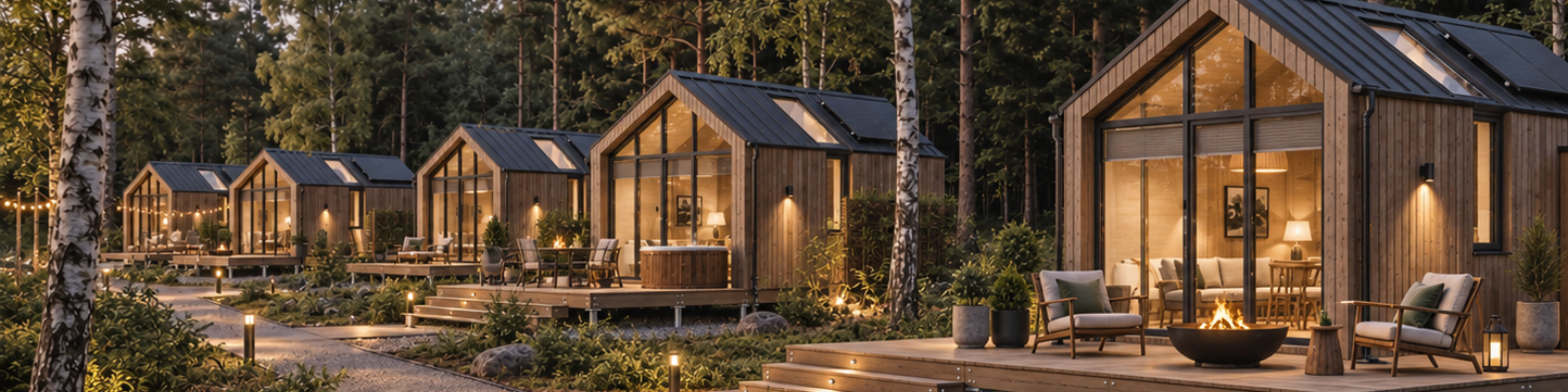
Sleep tourism is becoming a serious hospitality trend
Sleep is moving from being an assumed part of a hotel stay to something guests actively value.
The Global Wellness Institute identified sleep tourism and “sleep by design” among its major sleep trends for 2026. Its 2025 research also reported that 91% of frequent travellers surveyed would be willing to pay up to 10% more for sleep-enhancing accommodation. At the same time, 63% reported sleeping worse while travelling, with noise, lighting and bedding among the most commonly reported disruptors.
This is happening alongside the wider growth of wellness tourism. The Global Wellness Institute estimates global wellness-tourism expenditure reached approximately $894 billion in 2024.
For a holiday park developer, landowner or leisure developer, the opportunity is therefore not necessarily to add more obvious “wellness” features.
It may be to make the accommodation itself better at performing the fundamental job your guest came away for:
helping them switch off.
Wellness should start with the building, not the hot tub
Saunas, outdoor baths, plunge pools and treatment spaces can all create fantastic guest experiences.
But they are additions to a stay.
Sleep happens inside the building for seven, eight or more hours every night.
That means the walls, insulation, glazing, ventilation, temperature, acoustics, lighting and materials surrounding the guest could arguably be some of the most important wellness infrastructure on the entire site.
This is the principle behind what we call a deeper rest cabin.
It isn't one product or feature. It is a leisure space where the physical environment has been considered around the conditions that help people rest: fresh air, acoustic comfort, thermal stability, calm interiors, appropriate light and connection with nature.
And there is growing research behind several of those principles.
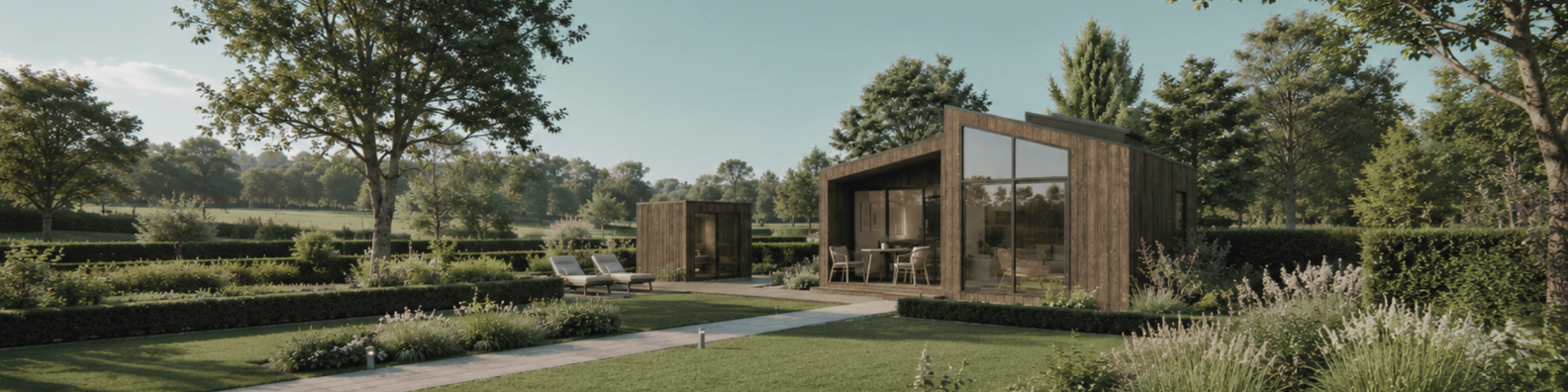
1. Stable temperature: comfort that holds through the night
A cabin may feel perfectly comfortable when a guest goes to bed at 10pm.
What matters is what happens afterwards.
Does the temperature fall significantly overnight? Are there draughts or cold surfaces near the bed? Does morning sun rapidly overheat the room? Is the heating system continuously compensating for a building envelope that loses heat too quickly?
Research reviewing thermal environments and sleep has concluded that a thermally comfortable sleeping environment is important for maintaining sleep.
This is why we believe thermal comfort should begin with fabric-first construction.
Insulation, airtightness, high-performance glazing and carefully designed junctions help reduce unwanted heat loss and sudden temperature swings. Heating and cooling can then complement the building rather than constantly compensate for its weaknesses.
For a leisure business, that has another potential advantage: accommodation intended to generate revenue throughout the year needs to perform in January as convincingly as it does in July.
A true premium stay should not be seasonal comfort dressed in expensive furniture.
2. Fresh air: what happens in the bedroom while guests sleep?
Indoor air may be one of the least photographed parts of a hospitality experience.
It may also be one of the most interesting.
CO₂ is commonly monitored in occupied bedrooms as an indicator of how effectively a space is being ventilated. It does not tell us everything about indoor air quality, nor should ordinary bedroom CO₂ levels be treated as a toxin measurement in isolation. But research examining ventilation and sleep has produced some compelling results.
A 2016 field experiment compared bedrooms experiencing average CO₂ levels of approximately 835 ppm and 2,395 ppm. With improved ventilation and lower CO₂, researchers recorded improvements in objectively measured sleep quality, perceived air freshness, next-day sleepiness, ability to concentrate and performance on a logical-thinking test.
More recently, a controlled study compared ventilation conditions producing average bedroom CO₂ concentrations of around 750, 1,000 and 1,300 ppm. Compared with 750 ppm, sleep efficiency fell by 1.3% at 1,000 ppm and 1.8% at 1,300 ppm, while time awake increased by approximately five and eight minutes respectively.
That is particularly relevant to compact hospitality accommodation.
Opening a window is not always a good ventilation strategy. In winter it can introduce cold draughts. At a roadside or busy holiday park it can also introduce noise. During pollen season it may bring more outdoor contaminants directly into the room.
Our approach is continuous mechanical ventilation, quietly supplying filtered fresh air and removing stale, moisture-laden air while the guest sleeps.
Across the NordSeries, we are working around low overnight CO₂ levels, with approximately 700–800 ppm under normal occupancy used as a performance benchmark, alongside humidity and wider indoor-environment monitoring.
Fresh air becomes part of the architecture rather than something the guest has to think about.
3. Acoustic comfort: leave more of the outside world outside
Imagine developing a beautiful woodland retreat only for guests to hear every passing car.
Or installing premium holiday lodges only for conversations from neighbouring units, rainfall or mechanical equipment to dominate the bedroom at night.
Noise and sleep are closely connected.
The World Health Organization identifies sleep disturbance as one of the established effects of excessive environmental noise and has historically recommended bedroom levels below approximately 30 dB(A) at night for good-quality sleep.
We are not currently claiming that every NordSeries building achieves a particular acoustic dB figure; our acoustic testing programme is still developing.
But the design principle is already fundamental.
Substantial wall, floor and roof construction, deep insulation and high-performance glazing all help soften external activity and create a more protected internal environment.
Sometimes the simplest demonstration is still the most powerful.
Step inside.
Close the door.
And notice how much of the world stays outside.
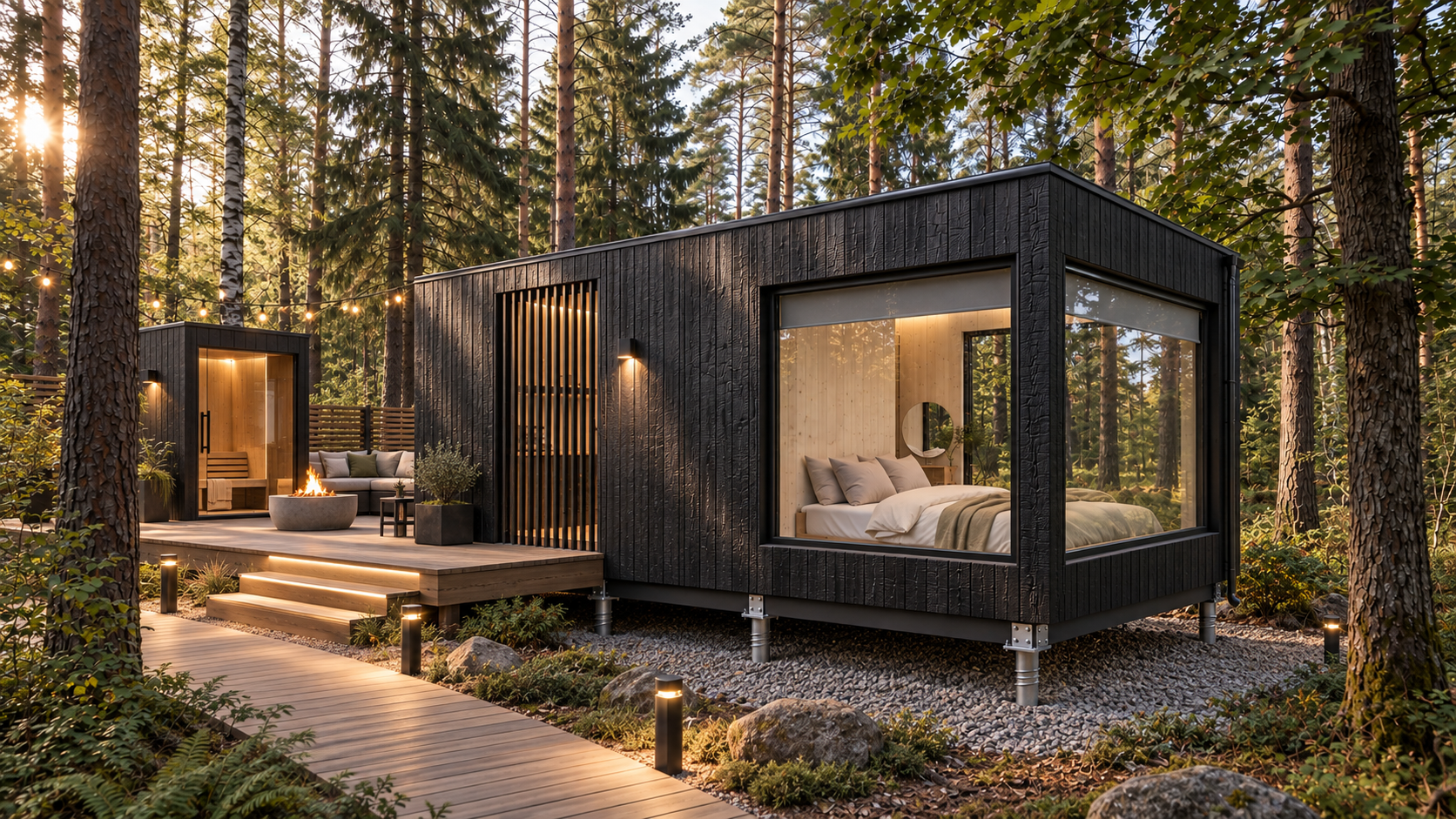
A deeper rest cabin isn't only for a wellness retreat
This thinking has applications across almost every part of leisure and hospitality development.
For a holiday park developer, deeper-rest accommodation could strengthen the proposition for premium, year-round holiday lodges rather than units differentiated predominantly through styling.
For a luxury glamping development, it provides an opportunity to move beyond the increasingly crowded market of attractive pods and create accommodation with a more defensible guest-experience story.
For a wellness retreat, the building can become part of the treatment philosophy. Breathwork, yoga, nature and recovery may happen during the day; the accommodation should not stop supporting that purpose when the guest goes to bed.
For vineyard accommodation, boutique hotels and country estates, quiet, beautifully designed cabins can extend a guest's experience of the landscape while creating additional overnight capacity.
And for wedding venues, on-site accommodation can become far more than somewhere for guests to sleep after the celebration. It can extend the entire experience into the following morning, particularly when the accommodation feels calm, private and genuinely restorative.
Different markets. The same human requirement.
We all need rest.
So can deeper rest actually increase profits?
We should be careful with this question.
There isn't a credible equation saying that lowering bedroom CO₂, improving insulation or reducing noise will automatically add a particular percentage to the profitability of a holiday park.
Development economics are far more complicated than that.
But there is a compelling commercial hypothesis.
Travellers are demonstrating greater interest in wellness and sleep-focused travel. Research suggests many are willing to pay more for sleep-enhancing accommodation. We also know that ventilation, thermal conditions and environmental noise can influence sleep quality.
For an operator, those factors ultimately sit alongside the things that determine whether a guest says:
That was beautiful.
or:
I haven't slept that well in months.
The second experience is considerably harder for a competitor to copy with a new kitchen colour or more expensive tap.
That is where we believe the commercial opportunity lies.
Not necessarily in selling “sleep” as another amenity, but in building a better guest experience that can support premium positioning, strong reviews, recommendations, repeat visits and year-round appeal.
We've spent nearly four years building around this principle
THC Homes is six years into its journey, and for close to four of those years we have been progressively focusing our construction and product development around these deeper-rest principles.
It has changed the questions we ask.
Not simply: Does the cabin look good?
But:
Will the temperature remain comfortable through the night?
How is fresh air reaching the bedroom?
What happens when the windows are closed?
How effectively does the construction soften external noise?
What materials surround somebody for eight hours while they sleep?
How does evening lighting affect the atmosphere?
Can we test what we are claiming?
That has led us towards high-performance building envelopes, controlled airtightness, mechanical ventilation, high-performance glazing, substantial insulation, natural materials and quieter, less visually stimulating interiors. And increasingly, we are testing the things guests cannot see: airtightness, indoor environmental conditions and acoustic performance.
Because we don't want deeper rest to remain marketing language.
We want to increasingly prove as well as feel the difference.
The next generation of leisure accommodation may be judged differently
For years, the leisure accommodation market has relied heavily on visible luxury.
More glass. More features. Bigger hot tubs. More elaborate interiors.
Those things aren't disappearing.
But we think another layer is emerging.
Guests are increasingly interested in how travel makes them feel.
That creates an interesting question for anyone planning a new holiday lodge site, luxury glamping retreat, vineyard stay, wedding venue development or wellness destination:
Are you designing somewhere that simply looks restful — or somewhere that has actually been built to support rest?
For us, that distinction defines the deeper rest cabin.
Deeper rest isn't something we add to our cabins. It's something we engineer into them.
If you're a landowner, holiday park operator or leisure developer considering your next accommodation project, you can experience these principles for yourself at the THC Homes Experience Space.
Because some of the most important qualities of a building simply cannot be understood through a brochure.
FAQ
What is a deeper rest cabin?
A deeper rest cabin is leisure accommodation designed around the environmental conditions that support rest, including stable temperature, continuous fresh air, acoustic comfort, appropriate lighting, natural materials and calm spatial design.
Can better ventilation improve sleep quality?
Research has associated improved bedroom ventilation with better objectively and subjectively measured sleep quality and improved next-day alertness and cognitive performance. CO₂ is frequently used as an indicator of ventilation effectiveness.
Are deeper rest cabins only suitable for wellness retreats?
No. The principles can be applied to holiday parks, luxury glamping destinations, boutique hotels, wedding venues, vineyards, estates and other hospitality developments where guest comfort and quality of stay matter.
What makes a deeper rest cabin different from a luxury glamping pod?
The distinction is less about a particular building type and more about the design brief. A deeper rest cabin considers how the structure, ventilation, acoustics, thermal envelope, materials, lighting and interior work together to support the guest experience rather than relying primarily on visible finishes or added amenities.