What Can Premium Guest Accommodation Add to Your Site?
More guest capacity. More months to sell. A premium stay designed to perform throughout the year.
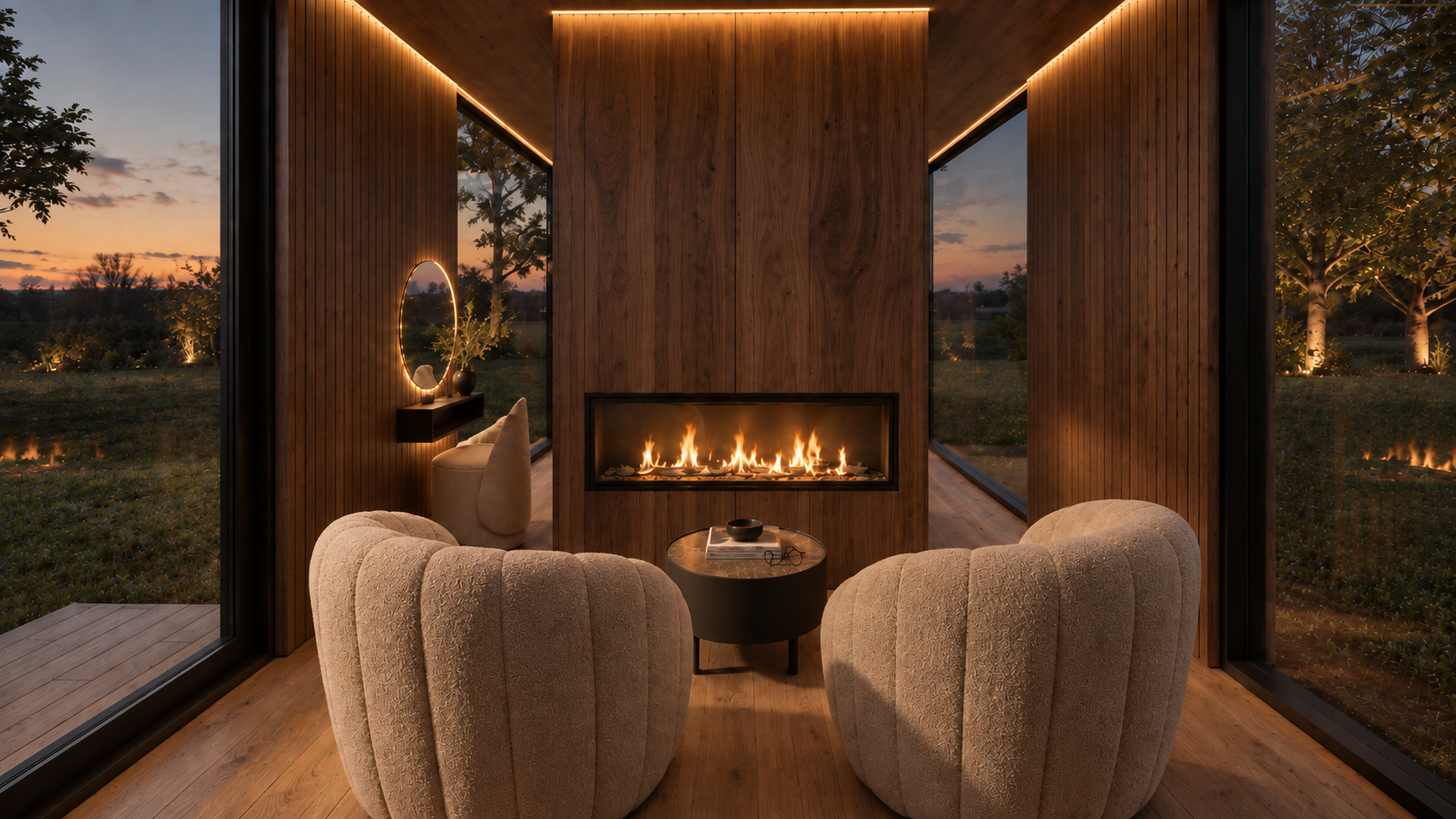
Romantic Couples Cabin - NordGlass Deeper Rest Cabin
If you operate a hotel, vineyard, wedding venue, leisure park, estate or retreat, adding guest accommodation can do far more than simply create another place to sleep.
The right premium accommodation can help you add new guest rooms, extend stays, keep more spending on site and create additional revenue from land you already have.
It can also give you something arguably even more valuable:
More of the year to sell.
Premium cabins and modular lodges can provide a practical way to expand without constructing a conventional hotel extension or large accommodation block.
But there is an important distinction between accommodation that can technically remain open all year and accommodation that has actually been designed for year-round premium hospitality.
At THC Homes, that distinction sits at the heart of NordSeries.
We engineer premium modular cabins and lodges around deeper rest, high building performance and genuine year-round comfort — because a room that photographs beautifully in July should still feel premium on a wet January night.
1. Add guest rooms without necessarily extending your main building
For many established hospitality businesses, the valuable asset already exists.
The land.
A boutique hotel may have gardens or grounds that could accommodate additional keys.
A vineyard may have unused land overlooking vines.
A wedding venue may regularly lose overnight guests to nearby hotels.
A leisure park may have an opportunity to introduce a higher-value accommodation tier.
A retreat may need more bedrooms without compromising the landscape or experience that makes the destination special.
Modular guest accommodation can allow additional rooms to be positioned around the site rather than added through one major conventional extension.
That can also make phased growth possible.
You may begin with several rooms, understand demand and guest response, then expand the accommodation offer as the commercial case develops.
THC's own project process is built around understanding the site, commercial objective, accommodation quantity and guest profile before agreeing the model, specification, delivery strategy and production plan.
But adding rooms is only useful if you can sell them.
Creating five additional rooms theoretically gives you five additional keys.
The more important commercial question is:
How many nights each year can those rooms realistically command a premium rate?
A beautiful cabin in June is relatively easy.
The doors are open. The landscape looks exceptional.
Guests spend much of the day outdoors.
The building itself is under relatively little pressure.
January asks much more of it.
Cold temperatures. Wind. Rain.
Windows closed overnight.
Two guests sleeping in a compact space for eight hours.
Heating running.
Moisture being generated through showers, cooking and breathing.
And a guest who has still paid for a premium experience.
That is where building quality becomes part of the business model.
2. Extend the season — rather than simply adding capacity
Many hospitality operators would like to generate more revenue outside the obvious spring and summer peaks.
But being open in winter and providing an excellent winter stay are not necessarily the same thing.
A space can contain a heater and remain technically usable.
That does not automatically mean it will feel like premium accommodation.
Draughts, changing temperatures, cold surfaces, poor ventilation, condensation and excessive heating demand can all become more apparent once outside temperatures fall.
NordSeries starts with a different philosophy:
Build the performance into the building first.
Our technical approach considers insulation, glazing, airtightness, thermal bridging, ventilation, moisture management and building services together, rather than treating them as independent features.
Walls typically sit around 0.15–0.18 W/m²K depending on the model and project, but we do not design around one wall value in isolation.
The whole building is considered.
A slimmer wall may make sense where internal space is particularly valuable.
Performance can then be balanced through other parts of the envelope, including the floor, roof, glazing, junctions and services.
This whole-building approach is fundamental to how NordSeries is developed.
Year-round availability is not the same as year-round comfort.
That distinction matters commercially.
If colder months mean: lower rates, more energy consumption, more guest complaints, greater condensation risk, or accommodation that simply feels noticeably less premium, the theoretical benefit of remaining open all year becomes much less valuable.
Conversely, accommodation designed around stable internal conditions creates more opportunities to sell the difficult months.
January retreats. Winter weddings. Christmas stays.
February weekend breaks. Autumn vineyard experiences. Spring wellness escapes.
The building cannot create demand by itself.
But it can give the operator a far stronger product to sell when the weather stops doing the work.
NordSeries is specifically designed around stable year-round comfort, with deep insulation, controlled airtightness, high-performance glazing and considered junctions used to reduce heat loss and temperature swings.
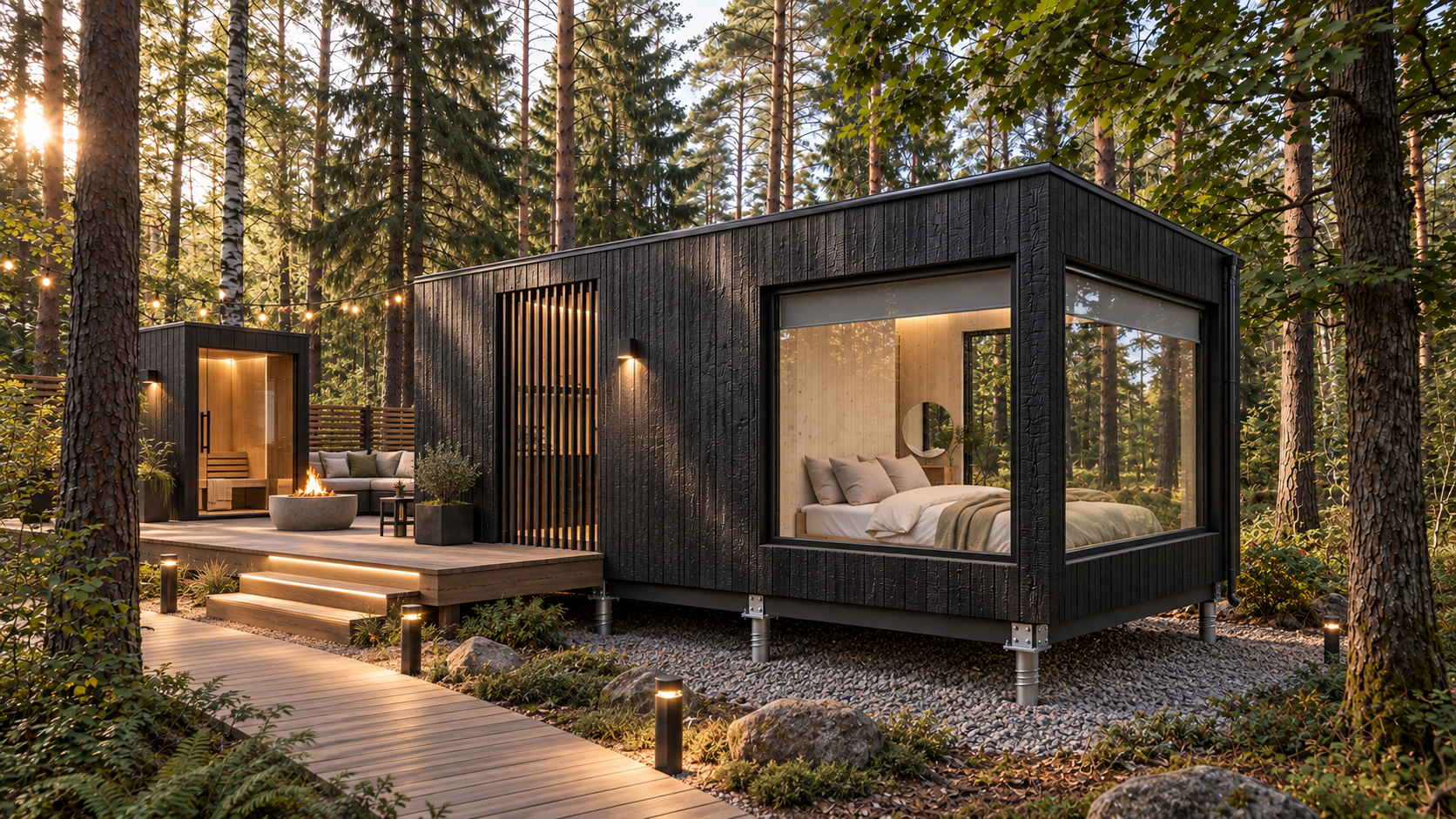
NordGlass NordSeries Deeper Rest Cabin
3. Protect the premium guest experience
Guests increasingly encounter beautiful accommodation online.
Large windows. Dark timber. A hot tub. Soft lighting.
An exceptional landscape.
These things help create the booking.
But the guest spends the night inside the building.
And once the door closes, the experience becomes much more sensory.
Is the temperature stable?
Does the room feel fresh in the morning?
Can you hear the neighbouring accommodation?
Does the bathroom feel damp?
Can you hear mechanical equipment through the night?
Are the materials pleasant to spend time around?
Can the room become dark enough to sleep?
Does it feel calm?
These are the details guests may never consciously analyse.
They simply experience the result.
That is why THC Homes developed the concept of deeper rest.
We believe premium hospitality should consider air, temperature, acoustics, light, materials and spatial design as one environment rather than relying on a mattress, sauna or hot tub to create “wellness”.
A good stay should do more than look impressive.
It should help the guest slow down, sleep well and leave feeling restored.
4. Fresh air should not require an open window in January
Air quality is one of the least visible parts of a guest stay.
It is also one of the most important.
Two people sleeping overnight in a compact room create moisture and carbon dioxide.
In summer, somebody may simply open a window.
That is less appealing at 2am in February.
NordSeries therefore uses designed mechanical ventilation to provide fresh filtered air while removing stale, moisture-laden air.
The aim is simple:
Guests should not have to choose between fresh air and thermal comfort.
Mechanical ventilation also helps manage humidity and reduce conditions that can contribute to condensation and mould.
This is why airtightness and ventilation have to be considered together.
A controlled building envelope reduces unwanted draughts.
Designed ventilation then determines where fresh air comes from and where stale air leaves.
5. Build accommodation as a long-term hospitality asset
There is another reason specification matters.
Hospitality accommodation works hard.
A room may be occupied for several nights at a time but cleaned and reset hundreds of times during its life.
Doors open repeatedly. Bathrooms remain wet. Furniture is moved. Suitcases hit walls.
Floors experience concentrated foot traffic.
Heating and ventilation operate continuously.
Cleaning products are used repeatedly.
This means a visually impressive interior is not enough.
The building needs to be designed for operation.
THC therefore considers the guest, operator and cleaner when developing NordSeries interiors. Storage, housekeeping access, furniture, bathrooms and maintenance are considered around repeated hospitality use rather than simply around how the space looks on completion.
Our technical construction philosophy follows the same principle.
A typical NordSeries wall can include external sugi ban charred timber cladding, ventilated cavity, weather barrier, insulated structural zone, airtight/vapour-control layer, protected service zone and internal finish.
The roof and floor form part of the same continuous performance envelope.
The intention is not to create a disposable seasonal product.
It is to create a premium hospitality building that performs, feels considered and can remain valuable to the operator over the longer term.
6. More nights can mean more than room revenue
Accommodation can change the economics of the wider site.
Consider a vineyard.
Without accommodation, somebody may arrive for a tasting, buy wine and leave.
With accommodation, the same visit can potentially become:
arrival, wine tasting, dinner, overnight stay, breakfast, another experience,
and additional purchases before departure.
The same principle applies elsewhere.
A wedding venue can keep guests on the estate overnight.
A hotel can increase its key count.
A retreat can create multi-day programmes.
A leisure destination can introduce premium packages.
A restaurant with land can become somewhere people travel to for an entire weekend rather than one meal.
The accommodation therefore has the potential to support spending far beyond the nightly rate.
This is why we believe the right starting question is not:
“How much does one cabin cost?”
It is: “What could additional accommodation unlock for this site?”
7. Can premium accommodation support higher nightly rates?
Potentially — but a premium building does not automatically create a premium rate.
Location, brand, experience, food, service, seasonality, local competition and demand all matter.
What high-quality accommodation can do is support the promise being made.
If a room is marketed as a luxury escape, the physical experience should justify that positioning.
Premium rates become much harder to defend when the guest experience deteriorates because the weather changes.
The building should therefore support the rate rather than work against it.
This is also why THC Homes does not define luxury primarily through decoration.
Natural materials, calm interiors and good design matter.
But so do the parts of the building guests rarely see.
The insulation.
Airtightness.
Glazing.
Ventilation.
Moisture strategy.
Acoustic detailing.
The photograph sells the expectation.
The building has to deliver it.
8. Why TEK17 matters for year-round luxury accommodation
NordSeries is developed around selected TEK17 performance principles.
TEK17 is Norway's technical building-regulation framework, developed for a climate in which high building performance is particularly important.
For THC Homes, its relevance is not about attaching a Scandinavian badge to the product.
It is about the engineering philosophy.
The building is considered as a system:
walls + roof + floor + glazing + airtightness + thermal bridges + ventilation + moisture + services + energy demand.
Our technical methodology uses selected TEK17 requirements and energy measures as part of the development baseline for NordSeries, while each project is considered as a complete building.
Passive House principles also influence how we think — particularly fabric-first design, reduced heat loss, controlled airtightness, thermal-bridge reduction and high-performance glazing — although NordSeries buildings are not described as certified Passive Houses.
9. Are luxury cabins suitable for Scotland and colder UK locations?
For accommodation intended for Scotland, Northumberland, exposed coastal sites or upland locations, winter performance deserves particular attention.
The question should not simply be:
“Does it have heating?”
A better question is:
“What is the heating trying to compensate for?”
In a poorly controlled building, heat can continually escape through air leakage, glazing, junctions and an underperforming envelope.
In a high-performance building, heating complements the fabric rather than trying to overcome its weaknesses.
That is the approach behind NordSeries.
The exact wall, floor and roof construction can be adapted around the individual model and project, with whole-building calculations used to understand how the specification works together.
This makes NordSeries particularly relevant where clients are looking for luxury lodges in Scotland, year-round cabins, winter guest accommodation or premium modular hospitality buildings for colder locations.
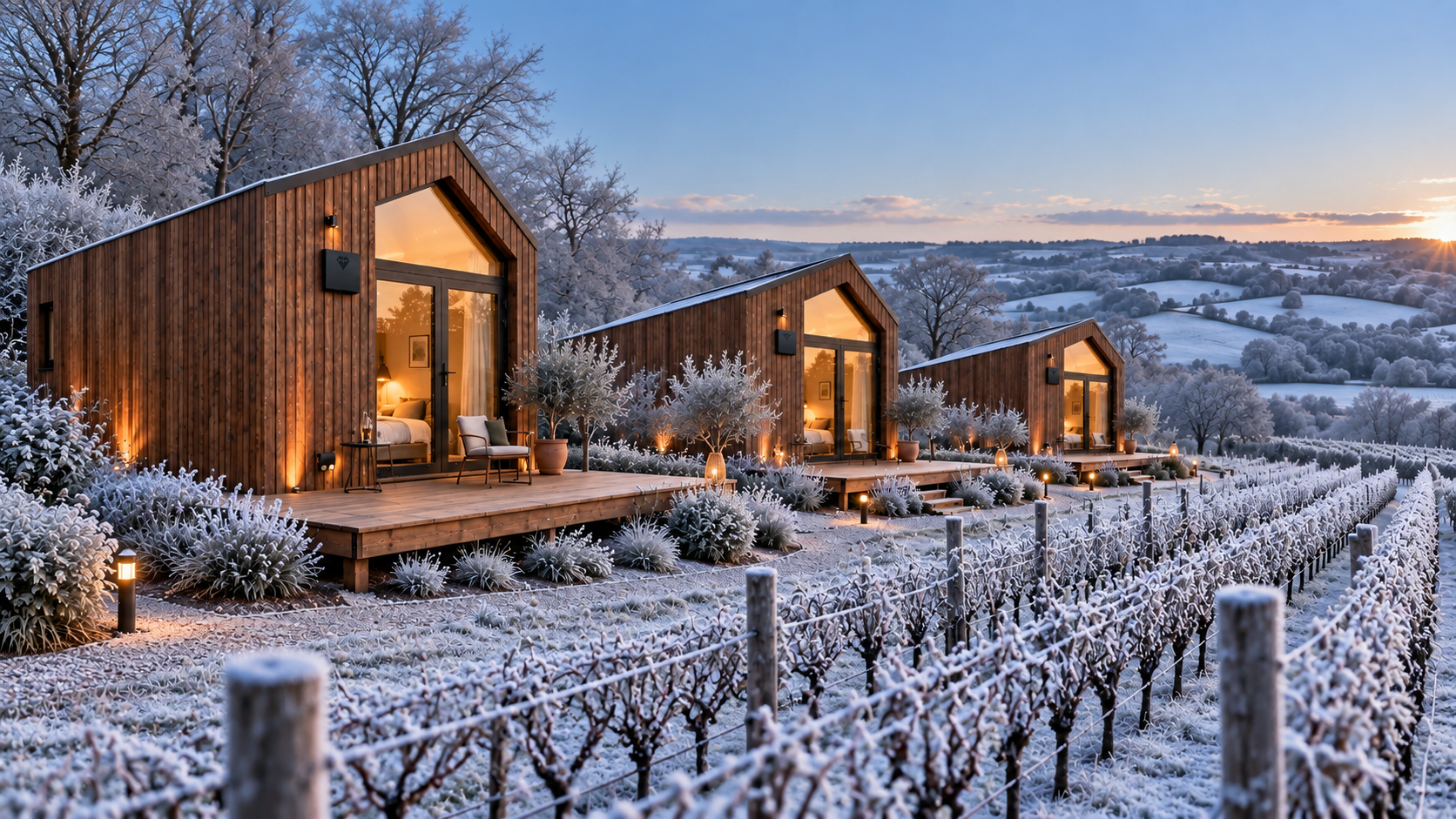
NordNest Deeper Rest Cabins
10. Which hospitality businesses can benefit from premium guest accommodation?
Luxury cabins for vineyards
Accommodation can turn shorter visits into overnight experiences and create more opportunities for food, wine, tastings and other on-site spending.
Guest accommodation for wedding venues
On-site bedrooms can allow couples and guests to remain at the venue rather than moving to external hotels, while also creating opportunities for additional-night stays and next-day experiences.
Premium lodges for leisure and holiday parks
New accommodation can create a higher-value category, replace ageing stock and potentially strengthen the year-round offer.
Modular hotel rooms for boutique hotels
Detached rooms can provide another way of increasing the number of keys where the site has suitable land but a conventional extension may not suit the property or guest experience.
Wellness retreat accommodation
The accommodation itself should support the wellness proposition through better sleep conditions, fresh air, quiet, stable comfort, natural materials and calmer interiors.
Luxury guest accommodation for estates and landowners
Existing land can potentially become part of a new hospitality concept, subject to planning, infrastructure, access and the wider commercial case.
How much does premium guest accommodation cost?
Price depends significantly on size, specification, quantity and project requirements.
As of Autumn 2026, NordSeries starts at £70,000 for the NordNest, with premium studio and lodge models ranging upwards and larger NordStar and NordGlade twin-module lodges currently priced at £140,500.
Bespoke development for larger projects starts from £90,000 per model, subject to specification.
For multi-unit developments, the more useful conversation is usually about the whole project.
Quantity. Specification. Production batches. Transport. Foundations. Cranage. Site infrastructure. Installation. Programme.
And the commercial objective behind adding the accommodation.
Larger developments allow these elements to be considered as one delivery strategy rather than simply multiplying the retail cost of one building.
View the current NordSeries collection and guide pricing → HERE
What should you ask before choosing premium guest accommodation?
Before selecting a cabin, lodge or modular guest room, consider seven things:
Can you handle all year round occupation?
What nightly rate does the business model require?
Who is the guest and how long will they stay?
What additional spending could an overnight stay create elsewhere on the site?
How will the building perform in the coldest and hottest months?
How will it be cleaned, maintained and repaired after repeated hospitality use?
Does the manufacturer understand the wider development — or are they simply supplying the building?
THC Homes starts with the site, guest, commercial objective and intended use because the right accommodation should support the wider business rather than simply occupy a piece of land.
Premium accommodation should give your site more opportunities to earn
The commercial case for new guest accommodation is rarely just about adding bedrooms.
It is about what those bedrooms enable.
More overnight capacity.
Longer guest stays.
Additional spend.
A stronger premium offer.
New winter packages.
More reasons for guests to remain on site.
And potentially more months of the year in which the accommodation can confidently be sold.
That is why we do not believe deeper rest begins with a hot tub, sauna or expensive mattress.
It begins with the building.
Fresh air.
Stable temperature.
Reduced noise.
Considered materials.
Calm design.
A space should look premium.
But more importantly:
it should still feel premium when the door closes.
THC Homes
We engineer spaces for deeper rest.
Planning premium guest accommodation for a hotel, vineyard, wedding venue, leisure destination, estate or retreat?
FAQ
Can I add luxury cabins to an existing hospitality site?
Potentially. Hotels, vineyards, wedding venues, leisure parks, retreats and estates can use modular guest accommodation to add overnight capacity, subject to planning, site access, infrastructure and the specific use of the land.
Can luxury cabins be used all year round?
Yes, where they have been designed and specified appropriately. NordSeries uses a high-performance envelope, controlled airtightness, high-performance glazing and designed ventilation to support stable year-round internal conditions.
Are premium cabins suitable for Scotland?
NordSeries can be engineered around colder and more exposed UK locations. THC uses selected TEK17 performance principles as part of its technical framework and considers the whole envelope, airtightness, glazing, ventilation and energy performance together.
What is the difference between a luxury lodge and a cheaper holiday unit?
Price alone does not define the distinction. Construction quality, insulation, airtightness, ventilation, glazing, moisture management, materials, durability and hospitality design can all materially affect how accommodation feels and performs.
Can modular cabins increase hotel capacity?
They can provide an alternative way of adding detached guest rooms or suites where the site and planning context support them, without necessarily creating a conventional hotel extension.
What does premium guest accommodation cost in the UK?
Current NordSeries pricing begins at £65,950, with larger formats and bespoke buildings costing more. Total development cost also needs to account for transport, foundations, cranage, site infrastructure and installation.
What is deeper-rest accommodation?
THC Homes uses “deeper rest” to describe an approach where air quality, thermal comfort, noise, light, materials and spatial design are considered together so the building itself supports how guests rest and feel.